
Armstrong Siddeley Heritage Trust
Armstrong Siddeley Stationary Diesel Engines
The 1930s saw increasing use of compression ignition oil engines, commonly called diesel engines, as power units for ships, commercial vehicles, railway locomotives, electricity generation and even aircraft. It was a market that Armstrong Siddeley Motors (ASM), with no previous experience of compression ignition
engines, was unprepared to enter.
The opportunity seemed to come in 1943 with the negotiation of a licence agreement with the North Eastern Marine Engineering Company (NEME) of Sunderland and Wallsend, builders of marine oil engines.
The minutes of the ASM board meeting held on 15 March 1943 noted that the project, known as the Nemesis Engine, was proceeding very well but the licensors had not replied to two letters regarding the period of notice. By December 1943 agreement had still not been reached with NEME on the terms of the licence.
The General Manager, Dr Rowell, said that he had considered alternative diesel engines and had asked Ricardo consulting engineers to send a representative.
Ricardo's report has not survived but it would appear that that the recommendation was for ASM to build air-cooled diesel engines based on the company's experience with air cooled, radial aero engines.

The engine that came on the market in 1946 had very little in common with the contemporary Cheetah aero engine. It had a single cylinder of 108 mm bore and a piston stroke of 108 mm giving a cylinder capacity of 988 cm3. The compression ratio was 15:1. Fuel oil was stored in a tank mounted above the engine, allowing gravity feed to the Bryce Berger injection pump. The heavy flywheel with integral cooling fan made a distinctive whine when the engine was running. Extensive use of cast iron resulted in a weight
of 540 lb (245 kg). Output power was 5 bhp at 900 rpm.
It does not sound like a best seller - but it was. In the postwar reconstruction there was a need for engines to drive generators, water pumps and other industrial and agricultural applications. Bamford International and Massey-Harris hay balers incorporated Armstrong Siddeley diesels as an auxiliary engines.
Each engine was built individually by a fitter in the former shadow factory at Walnut Street, Leicester before being despatched to Parkside, Coventry for testing, painting, packing and despatch. The engines soon gained a reputation for reliablity.

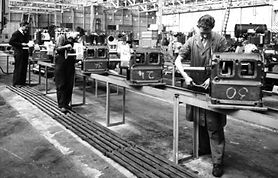

Starting with engine serial number DE1000 in 1946, serial numbers had already reached DE13023 in 1948 when the original rectangular fuel tank was replaced by a cylindrical tank.
The engine was progressively increased in power to 11 bhp at 1800 rpm. For constant speed applications the running speed, and hence the power, was set by fitting the correct stiffness springs in the engine governor.
In 1950 the range was extended with the introduction of a two cylinder engine with the same cylinder dimensions as the single cylinder engine. Many of the components were common to both engines. The two cylinder engine had a maximum output of 22 bhp at 1800 rpm. Some were fitted in canal narrow boats, including the British Waterways Admiral class. Many more were coupled to a Parsons Engineering gearbox and sold as Parsons “Merganser” power units.
By the mid-1950s orders exceeded production and there were delivery delays of up to 12 months.
A three cylinder version producing up to 33 bhp was introduced in January 1955. It was unfortunate timing as sales of all engines fell as a result of the Suez Crisis of 1956 and subsequent oil shortage. Only around 300 three cylinder engines were built.
The three cylinder engine was installed in canal tug boats and used for driving generators at remote military installations and mountain top radar stations in Norway where the air cooling was an advantage in freezing conditions.


Images of the Armstrong Siddeley Stationary Diesel Engines
The Leicester factory closed in August 1957 with the loss of 230 employees when production was moved to the Armstrong Siddeley factory at Brockworth, Gloucester (formerly Brockworth Engineering). At Brockworth production was organised on an assembly line with each operative performing just a few tasks.
The Brockworth operation was to be short lived. At the end of July 1957, Hawker Siddeley Group, of which Armstrong Siddeley was a part, bought the Brush Group of companies. Brush, best known for electrical engineering, was also a manufacturer of diesel engines and some rationalisation was inevitable.
The closure of the Brockworth factory was approved at the Armstrong Siddeley board meeting on 11 November 1958. At the same meeting it was reported that a new range of high speed diesel engines, replacing the existing diesel engines, was almost complete. The first engine was then on test.
Manufacture of the new range of Armstrong Siddeley diesel engines, designated AS1, AS2 and AS3 began at the former Bryce Berger factory in Staines, Middlesex in 1959 and continued until 1962. In an effort to retain
Armstrong Siddeley customers, Petters Ltd published a leaflet “Armstrong Siddeley Power” showing their range of diesel engines with Armstrong Siddeley transfers. Thus diesel engines were manufactured under the Armstrong Siddeley name well into the 1960s and long after ASM had ceased to exist as a manufacturing company.
Production records have not survived. From the serial numbers of engines that remain in existance and from other documents, there appear to have been at least 25,000 single cylinder engines built with DE-prefix serial numbers up to 1951 and at least 7,000 single cylinder engines with 1-prefix serial numbers to the end of Brockworth production. Serial numbers with T- or 2-prefix for the two cylinder engines suggest that at least 22,000 engines were built between 1950 and 1959. That is a total of well over 50,000 air-cooled diesel engines, probably more than the number of radial aero engines built by the company.
Although a few engines still remain in use, spares and technical support are now difficult to obtain. A number are operated by enthusiasts, exhibiting at events such as steam fairs. The Rolls-Royce Heritage Trust, Coventry Branch has two single cylinder engines, a two cylinder and a three cylinder engine in their care.


